Future-Ready Pre-Retirement Course:
Retirement Planning in Nigeria for a Wealthy, Healthy and Fulfilling Future
Have you thought carefully about the life you want after full-time employment?
Do you know how you will manage your retirement income, use your time, maintain your wellbeing and continue doing the things that give your life meaning?
Have you considered what you want to achieve during retirement—and what you need to put in place today to make that future more achievable?
Retirement is more than the end of a career. It is a major life transition that deserves thoughtful preparation.
For many Nigerians, the years leading up to retirement bring important questions about pension benefits, rising living costs, healthcare, accommodation, family responsibilities, financial independence and life beyond the workplace. Others want to know how to use their experience, skills and resources to create new opportunities after leaving employment.
What Is a Pre-Retirement Course?
A pre-retirement course is a structured educational program designed to help people prepare for the transition from full-time employment to retirement.
Rather than concentrating only on the date of retirement or the amount of pension a person expects to receive, a comprehensive program considers the practical, financial, personal and lifestyle questions that can influence retirement readiness.
The Future Ready Pre-Retirement Course, developed by Bibi Apampa, The Retirement Queen®, is designed around a holistic approach to retirement preparation. It brings together retirement planning, wealth building, healthy living, personal development, relationships, purpose and legacy.
The goal is to help you think beyond your retirement date and begin developing a practical plan for the future you want.
Whether you are a professional in your 40s or 50s, an employee approaching retirement, a manager responsible for employee development or a business owner preparing for your next chapter, retirement planning can help you identify your priorities and take informed steps towards your goals.
Your retirement future deserves more than hope. It deserves a plan.
SIGN-UP FOR THE FUTURE READY Pre-Retirement COURSE IN NIGERIA
Why Is Pre-Retirement Planning Important?
You may have spent decades building your career, developing professional skills, raising a family and contributing to your organization or business.
But have you given the same attention to planning the years after full-time work?
During employment, a regular salary may provide a predictable foundation for meeting household expenses and financial commitments. Retirement can change that arrangement. Your income sources, daily routines, responsibilities and priorities may all need to be reconsidered.
Without preparation, you may find yourself making important decisions under pressure. With preparation, you can begin identifying what needs attention while you still have time to investigate your options.
Pre-retirement planning can help you:
- Understand your pension arrangements and expected retirement resources.
- Assess your financial position, savings, assets and liabilities.
- Prepare a realistic retirement budget.
- Identify potential gaps between expected income and future expenses.
- Explore appropriate ways to manage retirement income and financial risks.
- Consider healthcare, wellbeing and lifestyle changes.
- Plan how to use your time meaningfully after employment.
- Strengthen important relationships and support networks.
- Organize relevant estate and legacy matters.
- Develop a personal retirement action plan.
Retirement preparation is not exclusively about accumulating money. It is about preparing for a life in which your financial resources, wellbeing, relationships and activities work together as far as possible.
For Nigerians, a useful plan should reflect personal circumstances, applicable pension arrangements, living costs, family responsibilities and individual goals. There is no single strategy that is right for everyone.
Introducing the Future Ready Pre-Retirement Course
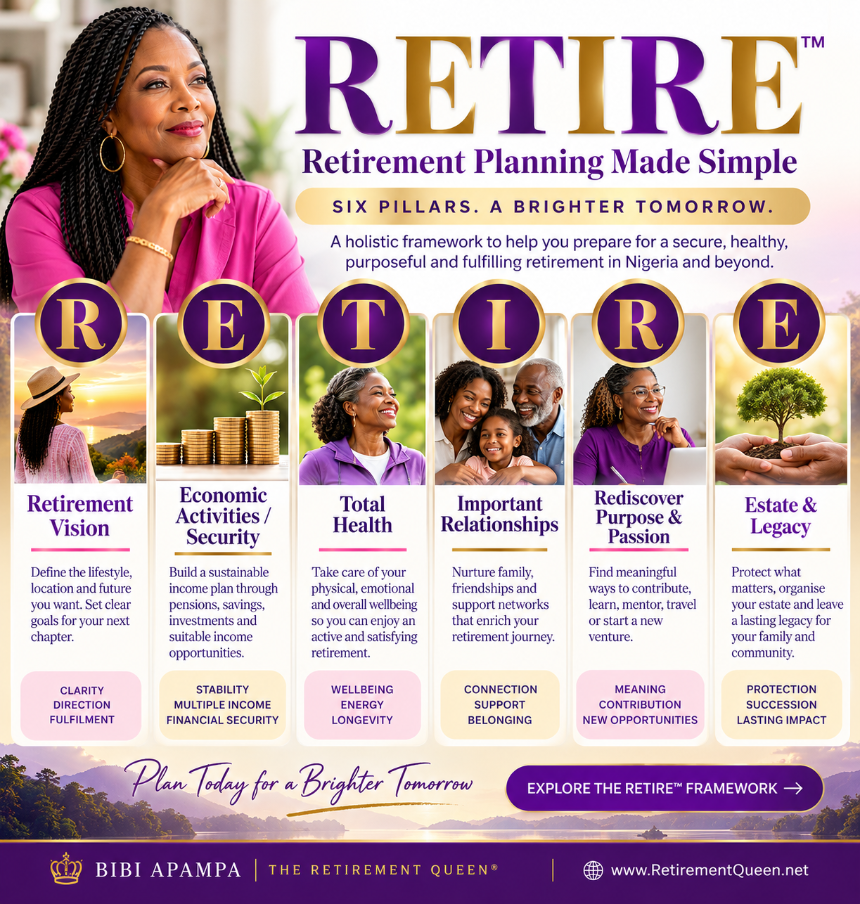
The Future Ready Pre-Retirement Course brings retirement preparation together in three practical stages, supported by the RETIRE™ Retirement Planning Made Simple Framework.
Rather than treating retirement as a single financial event, the program encourages you to consider the whole transition: where you are today, what you want your future to look like, and which steps may help you move towards it.
Your Learning Journey
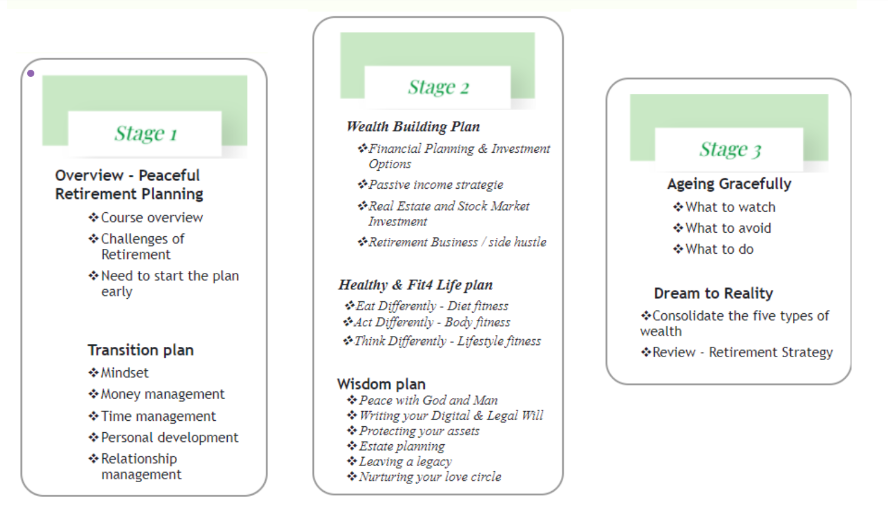
Opening Module — RETIRE™ Retirement Planning Made Simple Framework
Begin with a holistic overview of retirement readiness and the six pillars that shape your preparation.
Stage 1 — Overview: Peaceful Retirement Planning and Your Transition Plan
Understand the challenges of retirement and begin preparing mentally, financially and personally for life beyond work.
Stage 2 — Wealth Building, Healthy & Fit for Life, and Wisdom Plans
Explore the financial, health, lifestyle, relationship and legacy considerations that can support a more rounded retirement plan.
Stage 3 — Ageing Gracefully and Dream to Reality
Consider how to approach later life thoughtfully, bring your five types of wealth together and review your retirement strategy.
The course is designed to help you connect these subjects into a personal plan, rather than view each topic in isolation.
MODULE 1: RETIRE™ Retirement Planning Made Simple Framework
Six Pillars for a More Holistic Retirement Plan
Before examining the details of retirement budgeting, income, health or legacy, it helps to understand the different dimensions of retirement readiness.
The RETIRE™ Retirement Planning Made Simple Framework, championed by Bibi Apampa, The Retirement Queen®, offers a structure for considering six essential areas.
R — Retirement Vision
What kind of retirement do you want to create?
Think about where you would like to live, the activities you hope to pursue, the people you want to spend time with and the lifestyle that would feel meaningful to you.
Your retirement vision becomes a reference point for evaluating your financial, personal and lifestyle decisions.
E — Economic Activities / Security
How will you prepare financially for the years ahead?
Consider your expected pension benefits, savings, assets, expenses, financial commitments and possible income sources. Identify information gaps and explore appropriate approaches to managing financial risks.
Where investments, businesses or other income-generating activities are considered, their costs, risks and uncertainties should be assessed carefully. Returns are never guaranteed.
T — Total Health
What will help you maintain your wellbeing in retirement?
Consider your physical health, emotional wellbeing, healthcare arrangements, daily routines and the lifestyle choices that may support your quality of life.
Seek appropriate healthcare guidance for personal medical questions.
I — Important Relationships
Which relationships and support networks matter most to you?
Consider family, friendships, community, social connections and the conversations that may help everyone adjust to changing routines and responsibilities.
R — Rediscover Purpose & Passion
What will give your life meaning beyond your job title?
Explore interests, mentoring, teaching, volunteering, creative pursuits, consultancy, entrepreneurship or other activities that suit your circumstances and aspirations.
Retirement can be an opportunity to develop parts of yourself that received less attention during your working years.
E — Estate & Legacy
What do you want to protect, organise and pass on?
Consider your assets, important records, estate arrangements, business succession and the values or contributions you want to leave behind. Seek qualified legal and other professional advice where appropriate.
The RETIRE™ framework encourages you to consider retirement as a whole-life transition, with financial preparation connected to health, relationships, purpose and legacy.
Module outcome: Begin identifying your retirement priorities across all six pillars and use them to guide your personal retirement preparation.
Explore the full RETIRE™ Retirement Planning Made Simple Framework
STAGE 1: OVERVIEW — PEACEFUL RETIREMENT PLANNING
Prepare Your Mind and Life for the Transition
Retirement is a significant change. It can affect your income, daily schedule, professional identity, relationships and sense of purpose.
Stage 1 introduces the realities of retirement and encourages you to begin preparing before your final working day.
Lesson 1: Course Overview
Understand the purpose of the Future Ready Pre-Retirement Course and how its three stages fit together.
Identify the areas you most want to improve and begin thinking about the future you would like to create.
Lesson 2: Understanding the Challenges of Retirement
Explore common retirement concerns, including:
- Changes in income and financial responsibilities.
- Adjusting to a new daily routine.
- Maintaining a sense of identity and purpose.
- Managing changing family and social relationships.
- Preparing for healthcare and lifestyle needs.
- Making informed decisions about investments and other financial commitments.
The objective is not to make retirement appear frightening. It is to recognise that preparation can help you approach change more thoughtfully.
Lesson 3: Why You Need to Start Planning Early
Consider the advantages of giving yourself time to gather information, understand your benefits, review your finances and explore your options.
If retirement is approaching soon, you can still begin by identifying urgent questions and prioritising the decisions that matter most.
Your Transition Plan
Retirement involves more than financial adjustments. It may require new routines, expectations and ways of using your time.
Lesson 4: Mindset
Examine your expectations about retirement and identify beliefs that may influence your decisions.
Consider how you can approach this next chapter with realistic expectations, openness to change and a willingness to learn.
Lesson 5: Money Management
Review the importance of budgeting, managing liabilities, understanding income and expenditure, and organising financial information.
Begin identifying the figures and documents you need for a more informed retirement plan.
Lesson 6: Time Management
Think about how your days may change when employment no longer determines your schedule.
Consider creating a routine that balances rest, meaningful activities, family, personal interests and responsibilities.
Lesson 7: Personal Development
Identify the skills, interests and opportunities you want to develop.
This might include learning a new skill, writing, mentoring, teaching, exploring a business idea or pursuing a long-standing interest.
Lesson 8: Relationship Management
Consider how retirement may affect your relationships with family, friends, former colleagues and your wider community.
Think about communication, shared expectations, boundaries and the importance of maintaining meaningful social connections.
Stage 1 outcome: A clearer understanding of retirement and an initial transition plan covering mindset, money, time, personal development and relationships.
STAGE 2: WEALTH BUILDING, HEALTHY & FIT FOR LIFE, AND WISDOM PLANS
Build a Retirement Strategy That Goes Beyond Money
A fulfilling retirement depends on how you prepare for the different parts of your life. Stage 2 brings together three important areas: wealth building, health and wellbeing, and wisdom, protection and legacy.
Part A: Your Wealth Building Plan
Lesson 9: Financial Planning and Investment Options
Understand why retirement financial planning begins with a clear picture of your current position and future needs.
Topics may include:
- Reviewing income, expenditure, savings, assets and liabilities.
- Understanding relevant pension arrangements and retirement benefits.
- Preparing a retirement budget.
- Identifying possible gaps between expected income and expenses.
- Understanding risk, diversification, liquidity, costs and investment time horizons.
- Knowing when to seek qualified financial or investment advice.
Investment decisions should reflect your objectives, circumstances, risk tolerance and the rules that apply to you. No investment approach can guarantee retirement wealth.
Lesson 10: Developing a Passive Income Strategy
Explore the concept of income that may continue without requiring the same level of daily involvement as a conventional job.
Depending on personal circumstances, possible areas to investigate may include income-producing investments, rental property, royalties or established businesses with appropriate systems.
It is important to distinguish passive income from income that requires substantial ongoing work, capital or risk. Every opportunity should be researched, and earnings should never be assumed or guaranteed.
Lesson 11: Real Estate and Stock Market Investment
Learn the questions to ask before considering property or stock market investments as part of a retirement strategy.
Areas for consideration include:
- Understanding the risks and costs associated with property ownership.
- Considering property maintenance, vacancies, liquidity and legal documentation.
- Learning about shares, funds, diversification and market volatility.
- Understanding investment fees, taxes and relevant regulations.
- Avoiding decisions based solely on rumours, hype or promises of unusually high returns.
The purpose of this lesson is to improve understanding and encourage informed decision-making, not to recommend a particular investment without assessing individual circumstances.
Lesson 12: Retirement Business and Side Hustles
Consider whether a business, consultancy, freelance service or other income-generating activity could fit into your retirement plan.
Potential areas to investigate include using existing professional expertise, teaching, writing, mentoring, digital products or a small business that matches your skills and resources.
Before committing money, assess customer demand, start-up costs, operating requirements, time commitments and the possibility of loss.
Wealth Building Plan outcome: Identify the financial questions, income possibilities and next steps that deserve further investigation in your personal retirement plan.
Part B: Your Healthy & Fit for Life Plan
Retirement is an opportunity to pay greater attention to your wellbeing. The purpose of this section is to encourage thoughtful lifestyle choices and appropriate professional guidance.
Lesson 13: Eat Differently — Diet and Nutrition
Consider how your eating habits may support your wellbeing as you grow older.
Explore the value of balanced nutrition, appropriate hydration and sustainable habits. Personal dietary needs can vary, so consult a qualified healthcare professional for advice specific to your circumstances.
Lesson 14: Act Differently — Body Fitness
Think about the role that suitable physical activity, mobility, strength and regular movement may play in your daily routine.
Consider activities appropriate to your abilities and health. Seek medical guidance before making significant changes if you have concerns about your health or exercise capacity.
Lesson 15: Think Differently — Lifestyle Fitness
Reflect on your daily routines, stress management, emotional wellbeing and the activities that help you feel engaged.
Consider how you might create a balanced retirement lifestyle that allows for rest, social connection, personal interests and meaningful activity.
Healthy & Fit for Life outcome: Identify practical wellbeing priorities and lifestyle habits to discuss or develop as appropriate to your needs.
Part C: Your Wisdom Plan
Wisdom is reflected in how you manage relationships, protect your interests, prepare your affairs and consider the contribution you want to make to others.
Lesson 16: Peace with God and People
For participants whose faith is important to them, consider the role of spiritual reflection, faith communities and personal values in retirement.
Also reflect on relationships, unresolved issues, forgiveness, communication and the value of maintaining supportive connections.
This lesson should respect the fact that participants may have different beliefs and personal approaches to spirituality.
Lesson 17: Writing Your Digital and Legal Will
Understand the importance of organising your affairs and considering what should happen to your assets and important records.
Topics may include:
- Understanding the purpose of a legally valid will.
- Identifying assets and relevant documents.
- Considering how digital accounts and records should be handled.
- Understanding the importance of appropriate executors or representatives.
- Seeking qualified legal advice on requirements applicable to your circumstances.
A digital record of your wishes does not necessarily constitute a legally valid will. Formal requirements vary by jurisdiction.
Lesson 18: Protecting Your Assets
Consider the importance of maintaining accurate records, protecting property documentation and being alert to fraud and financial exploitation.
Review risks that may affect your assets and identify areas where qualified legal, financial or insurance advice may be appropriate.
Lesson 19: Estate Planning
Explore how estate planning can help you organise your affairs and communicate your wishes.
Depending on your circumstances, this may involve property ownership, beneficiary arrangements, business interests, family responsibilities and other legal considerations.
Estate planning should take account of applicable law and your individual situation.
Lesson 20: Leaving a Legacy
Consider what you want your life, work, values and contribution to mean to the people and communities that matter to you.
Legacy can include financial assets, but it can also involve knowledge, mentorship, service, family traditions and the example you set for others.
Lesson 21: Nurturing Your Love Circle
Reflect on the relationships you want to maintain and strengthen in retirement.
Consider making time for family and friends, building supportive social connections and establishing routines that allow you to remain engaged with the people who matter to you.
Wisdom Plan outcome: Identify important matters relating to relationships, personal values, asset protection, estate arrangements and legacy that may need attention.
STAGE 3: AGEING GRACEFULLY AND TURNING YOUR DREAM INTO REALITY
Put Your Retirement Preparation into Action
Planning is most useful when it informs the decisions and actions you take. Stage 3 brings together the lessons from the course and encourages you to review your plan as your circumstances change.
Part A: Ageing Gracefully
Lesson 22: What to Watch
Consider the areas that may need regular attention as you move through retirement.
These may include changes in spending, financial risks, health and mobility, social connections, housing needs, scams and changes in personal circumstances.
The purpose is to encourage awareness and timely action, rather than anxiety about ageing.
Lesson 23: What to Avoid
Examine common risks that can undermine retirement preparation, such as:
- Making financial decisions without adequate information.
- Investing money you cannot afford to lose in unsuitable ventures.
- Trusting promises of guaranteed or unusually high returns.
- Neglecting important records and legal arrangements.
- Becoming socially isolated.
- Ignoring changing needs or refusing to review an outdated plan.
Lesson 24: What to Do
Identify constructive habits that may help you manage retirement more thoughtfully.
These could include reviewing your budget, keeping records organised, maintaining social connections, pursuing meaningful activities, seeking professional advice when needed and periodically reassessing your goals.
Part B: Dream to Reality — Consolidating Your Five Types of Wealth
A distinctive feature of the Future Ready approach is its emphasis on five types of wealth to consider when preparing for retirement.
1. Financial Wealth
Your financial resources may include pension benefits, savings, investments, business interests and other assets, depending on your circumstances.
The objective is to understand your resources, spending needs and risks and develop a realistic approach to managing them.
2. Time Wealth
Retirement can give you greater control over how you use your time.
Consider how you want to balance rest, personal interests, family, learning, service and any work or business activities you choose to continue.
3. Social Wealth
Relationships and social connections can contribute significantly to a fulfilling life.
Think about the people, groups and communities that matter to you and how you will maintain meaningful connections after leaving employment.
4. Physical Wealth
Your health and physical capabilities influence many aspects of daily life.
Consider appropriate healthcare, sustainable routines, mobility, wellbeing and the support you may need as your circumstances change.
5. Generational Wealth
Consider what you want to preserve and pass on to future generations.
This may include financial assets, property, business interests, knowledge, values, education and other contributions. Appropriate planning can help you consider how to protect your interests and communicate your wishes.
These five types of wealth are not a promise that every person will achieve a particular outcome. They are a way of broadening the retirement conversation so that preparation includes more than financial assets alone.
Part C: Review Your Retirement Strategy
Lesson 25: Bringing Your Retirement Plan Together
Review the work you have done throughout the programme.
Ask yourself:
- What do I want my retirement to look like?
- What do I know about my pension benefits and other resources?
- What are my expected essential and discretionary expenses?
- What financial information do I still need?
- What health, lifestyle or relationship priorities deserve attention?
- What activities will give my life meaning?
- What estate or legacy matters need professional guidance?
- Which actions should I take first?
- When will I review my plan again?
Use your answers to develop or update your personal retirement action plan. Where appropriate, identify realistic priorities, target dates and the professionals or organisations you need to consult.
Stage 3 outcome: A more integrated view of your retirement priorities and a practical list of next steps to work through.
The Future Ready Difference: Planning for the Whole of Retirement
A retirement plan that focuses exclusively on money may leave important questions unanswered.
How will you spend your time? What will keep you engaged? How will you maintain meaningful relationships? What will help you protect your wellbeing and organise your affairs?
Future Ready brings these questions together through its three-stage course structure and the RETIRE™ Retirement Planning Made Simple Framework.
The course is designed to help participants:
- Understand the practical challenges associated with retirement.
- Identify financial information and decisions requiring attention.
- Explore retirement income concepts and possible wealth-building approaches.
- Consider health, lifestyle and relationship priorities.
- Reflect on purpose, personal development and meaningful activity.
- Understand the importance of asset protection and estate preparation.
- Consider financial, time, social, physical and generational wealth.
- Develop a structured personal retirement action plan.
The programme is educational. It cannot guarantee a particular level of wealth, investment return, health or retirement outcome. Its purpose is to support informed preparation and more thoughtful decision-making.
Who Is the Future Ready Pre-Retirement Course For?
The programme is intended for people who want to prepare more deliberately for life beyond full-time employment.
Professionals in their 40s and 50s
If you still have years before retirement, you may benefit from reviewing your financial position and beginning to clarify your future priorities.
Employees approaching retirement
If your retirement date is approaching, you may need to understand your benefits, review your finances, consider lifestyle changes and identify the decisions that require attention first.
Senior managers and executives
Senior professionals may want to consider their retirement resources, professional identity, leadership transition and opportunities to contribute in a different way after employment.
Self-employed people and business owners
If you do not have a conventional employment pathway, your retirement planning may involve personal savings, business continuity, ownership, succession and possible future income sources.
Women preparing for retirement
Women may have a range of financial circumstances and responsibilities, including caregiving, career breaks, family support and changing household needs. A retirement plan should reflect each individual's actual circumstances and aspirations.
Employers and human resources teams
Organisations may wish to provide retirement education to employees as part of staff development and preparation for the transition out of work.
The programme's relevance will depend on individual needs and the final course format. Please enquire to confirm the planned offering.
Retirement Training for Organisations in Nigeria
Employers and HR teams can play a constructive role in helping employees prepare for retirement by making relevant education available before important decisions become urgent.
Retirement training may address pension awareness, financial preparation, retirement budgeting, wellbeing, lifestyle transition, personal goals and the development of a retirement action plan.
The Future Ready course structure may provide a foundation for discussions with organisations interested in employee retirement education.
Potential areas for corporate training include:
- Understanding retirement readiness.
- Preparing for changes in income and expenditure.
- Considering pension information and relevant benefits.
- Exploring health, lifestyle and personal transition.
- Understanding the importance of relationships, purpose and legacy.
- Identifying personal questions and next steps.
The appropriate content and format will depend on the organisation's objectives, participants and available programme arrangements.
Are you an HR director, employer or organization interested in retirement training for employees?
Contact Retirement Planning Nigeria team to discuss your requirements and express interest in future corporate training opportunities.
ENQUIRE ABOUT CORPORATE RETIREMENT TRAINING
How to Get Started with Retirement Planning
You do not need to have every answer before you begin. A useful first step is to identify the areas where you need more clarity.
Step 1: Define your retirement vision
Think about your preferred lifestyle, where you want to live, the activities that matter to you and the people you want to spend time with.
Step 2: Review your financial position
Gather the information you need about income, expenditure, pension benefits, savings, assets and liabilities. Consult relevant professionals when necessary.
Step 3: Identify your preparation gaps
Consider the financial, health, relationship, purpose and estate matters that need further attention.
Step 4: Prioritize your next actions
Choose practical steps based on urgency, importance and your circumstances. Avoid assuming that every issue can or must be resolved at once.
Step 5: Review your plan regularly
Your circumstances, goals and available information may change. Review your plan periodically and adjust it when appropriate.
The RETIRE™ framework can help you keep the different dimensions of retirement in view as you work through these steps.
Frequently Asked Questions
About Pre-Retirement Courses in Nigeria
1. What is the Future Ready Pre-Retirement Course?
Future Ready is a retirement preparation program developed by Bibi Apampa, The Retirement Queen®. Its curriculum brings together retirement planning, wealth building, health and wellbeing, personal development, relationships, estate planning and legacy. It is structured around three core stages, with the RETIRE™ framework introduced as the opening module.
2. What makes Future Ready different from other retirement courses?
Future Ready takes a holistic approach to retirement. Alongside financial preparation, it considers time, social connections, physical wellbeing, purpose and generational wealth. Its RETIRE™ framework provides six pillars for organizing these considerations.
3. Who should take a pre-retirement course?
A pre-retirement course may be useful for professionals, employees approaching retirement, senior managers, business owners and others who want to prepare for life beyond full-time employment. The most appropriate program depends on your circumstances and learning needs.
4. When should I start planning for retirement?
It is generally helpful to start as early as practical because early preparation can provide more time to gather information, understand your benefits and consider options. If retirement is approaching soon, you can still prioritize the most important questions and take practical steps.
5. What will I learn in the Future Ready course?
The planned curriculum includes retirement readiness, mindset, money management, time management, personal development, relationships, financial planning, investment awareness, passive income concepts, real estate and stock market considerations, retirement business ideas, health and wellbeing, wills, asset protection, estate planning, legacy and the five types of wealth.
The course also includes the RETIRE™ Retirement Planning Made Simple Framework and a review of your retirement strategy.
6. What is the RETIRE™ Retirement Planning Made Simple Framework?
RETIRE™ is a six-pillar educational framework:
- R — Retirement Vision
- E — Economic Activities / Security
- T — Total Health
- I — Important Relationships
- R — Rediscover Purpose & Passion
- E — Estate & Legacy
It encourages a broader approach to retirement preparation by considering financial, personal, social and legacy-related priorities together.
7. Does the course cover pension planning in Nigeria?
The curriculum includes pension awareness and retirement financial preparation. Participants should obtain information relevant to their own pension arrangements from their pension administrator and consult the National Pension Commission (PenCom) for authoritative information about Nigeria's regulated pension system where applicable.
The course does not replace individual pension determinations or specialist pension advice.
8. Does Future Ready teach investment and passive income strategies?
The curriculum includes education about financial planning, investment options, passive income concepts, property, stock market investing and retirement business ideas. These subjects should be approached with careful consideration of costs, risks, regulations and individual circumstances. No investment, business or income outcome is guaranteed.
9. Does the course cover health and relationships
Yes. The planned curriculum includes a Healthy & Fit for Life section addressing nutrition, physical activity and lifestyle wellbeing, alongside lessons about relationships, personal development and meaningful activity. Personal medical questions should be directed to appropriate healthcare professionals.
10. Does the course cover wills and estate planning in Nigeria?
Yes. The Wisdom Plan includes topics relating to digital and legal wills, asset protection, estate planning, legacy and relationships. Participants should obtain qualified legal advice about the requirements that apply to their own circumstances.
11. Is Future-Ready available online or in person?
The course is a stand-alone course online and in-person by The Retirement Planning Nigeria team. Please enquire about current availability, online learning, in-person workshops, coaching options, schedules and fees before making a commitment.
12. Can employers arrange retirement training for their staff?
Employers and HR teams can express interest in future corporate retirement training. The proposed content and delivery format would need to be discussed and confirmed according to the organization's objectives and program availability.
13. Do I need financial knowledge before taking the course?
The material is intended to support retirement education in an accessible way. You do not need to know every technical detail before beginning to prepare. However, individual investment, pension, tax and legal decisions may require qualified professional guidance.
14. Will the course guarantee that I become wealthy or retire without financial worries?
No course can guarantee wealth, investment returns or a particular retirement outcome. Your results depend on your circumstances, resources, decisions, economic conditions and other factors. Future Ready is designed to support education, planning and informed action rather than promise a guaranteed result.
15. How can I find official pension information in Nigeria?
Consult the National Pension Commission (PenCom) and your pension administrator for information relevant to your pension arrangements. Always verify that the information applies to your employment and circumstances.
16. How can I enquire about Future Ready?
Use the Contact Us to ask about the course, its planned content, delivery formats and anticipated availability.
Begin Preparing for Your Future Today
Your retirement years deserve thoughtful preparation.
Whether your vision includes greater financial confidence, time for family, meaningful work, personal development, improved wellbeing or a lasting legacy, the first step is to consider what matters to you and what you need to do to prepare.
The Future Ready Pre-Retirement Course brings together practical retirement planning, wealth-building education, healthy living, wisdom and legacy through a structured three-stage learning journey supported by the RETIRE™ Retirement Planning Made Simple Framework.
It is designed to help you move from thinking about retirement to identifying the actions that can make your preparation more purposeful.
Retirement is not simply the end of a career. It is a new chapter worth preparing for
Express Your Interest in Future Ready Pre-Retirement Course
If you are interested in the Future Ready Pre-Retirement Course, online retirement learning, in-person workshops, one-to-one coaching or retirement training for your organization, contact us to discuss planned program options and availability.
EXPRESS INTEREST IN FUTURE READY
ENQUIRE ABOUT CORPORATE RETIREMENT TRAINING]
EXPLORE THE RETIRE™ FRAMEWORK]
About Bibi Apampa — The Retirement Queen®
Bibi Apampa, fondly known as The Retirement Queen®, is a retirement consultant, retirement wealth strategist, coach, chartered accountant, speaker and author. Her work focuses on retirement preparation, financial readiness and helping people think strategically about life beyond full-time employment.
Through retirement education, training and coaching initiatives, she promotes a more holistic approach to preparing for retirement—one that considers financial resources alongside health, relationships, purpose and legacy. Learn more at RetirementQueen.org.
Educational Disclaimer
This page and the Future Ready course outline are intended for general educational purposes. They do not constitute individualized pension, investment, financial, tax, legal or medical advice. Investment and business activities involve risks, and outcomes cannot be guaranteed. Verify relevant information and seek appropriately qualified professional advice before making decisions that affect your finances, legal affairs or health.
Explore Related Retirement Resources
Continue exploring the specialist resources and services available across Retirement Planning Nigeria.
· Invite Bibi Apampa, The Retirement Queen®, to speak at your next event